There is a point each year when the way we experience our homes begins to change.
The evenings draw in, lamps are switched on earlier and rooms that felt bright throughout summer suddenly depend much more heavily on artificial light. Nothing in the space has necessarily changed, but the atmosphere has.
Autumn is a useful moment to look at lighting again. Not necessarily as part of a complete redesign, but as an opportunity to understand what a room needs once daylight fades. These autumn lighting ideas are designed to help you spot where more warmth would help, where another layer of light could add depth and whether the lighting still reflects how the space is actually being used.
Throughout, our Founder Mara Rypacek Miller shares a few of her own thoughts on how placement, contrast and material can shape the way a room feels after dark.
Five ways to reset your lighting for autumn:
1. See the room after dark
2. Create contrast, not darkness
3. Pay attention to the corners
4. Choose warmer lighting for autumn
5. Identify what the room is missing

1. See the room after dark
We often make decisions about interiors during the day, when natural light fills the room and reveals colour, texture and detail with very little help. By autumn, we begin spending much more of our time at home after the daylight has faded.
That shift can reveal things that were easy to overlook through spring and summer. A corner disappears into shadow. A reading chair does not have enough light beside it. The centre of the room feels bright while everything around it falls away.
“We spend so much time thinking about rooms in daylight, but for a large part of the year we experience them after dark. Autumn is a good opportunity to look at your home again and ask whether the lighting still supports how you actually live in it.” - Mara
Before deciding what to change, spend an evening noticing which lights you naturally reach for and which areas of the room still feel unresolved. That gives you a much clearer idea of whether the answer is a small adjustment, a different bulb or an additional source of light.
One useful trick is to photograph the room from the doorway once the sun has gone down. Looking at the space on a screen rather than standing inside it can make overly bright areas, dark corners and gaps between light sources much easier to notice.
[SIDE-BY-SIDE]


2. Create contrast, not darkness
Creating a warmer atmosphere is not about making the entire room dimmer. What matters more is the relationship between brighter areas, softer pools of light and the shadows between them.
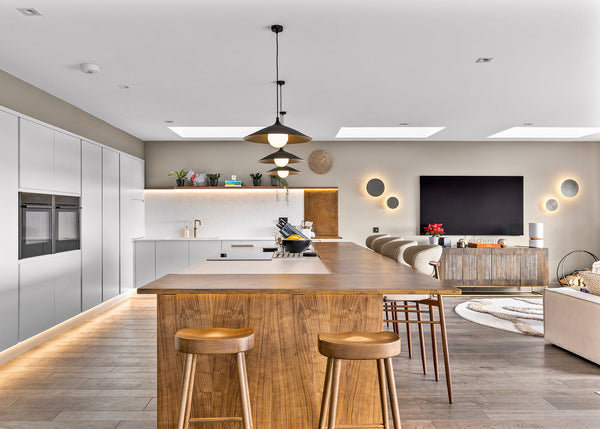
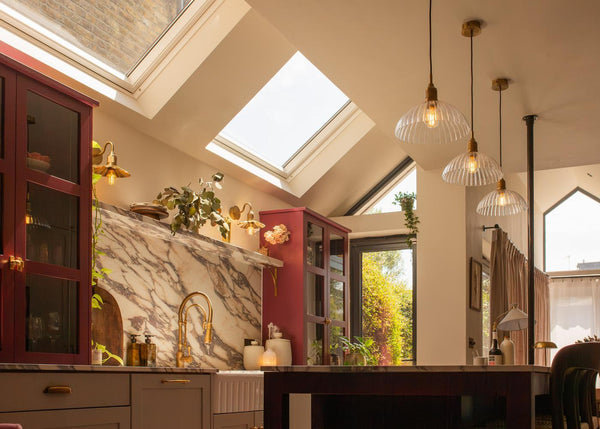
A table lamp might create a pool of light beside a sofa. A wall light can draw attention to artwork or texture. Pendant lights can define a dining table while the rest of the room sits at a lower level.
Used together, these different layers give a space depth and allow the eye to move naturally around the room. If the scheme feels flat, the answer may not be a brighter light, but a new source positioned at a different height or in a different part of the room.
“A cosy room isn’t necessarily a dark room. What makes it feel comfortable is contrast. You want places for the eye to settle, with different levels of light rather than one uniform wash across the whole space.” - Mara
If one central ceiling light is currently doing most of the work, try switching it off for an evening. Turn on several smaller light sources instead and look at what changes. It can quickly reveal where your existing lighting is working and where another layer could make the room feel more balanced.

Bring the light closer
Another simple way to change how a room feels is to bring light down from the ceiling and closer to the places where life actually happens.
Floor lamps and table lamps are particularly useful because they introduce light at a lower level. A lamp beside the chair you read in most often can make that part of the room feel more useful and more inviting, while a fitting on a sideboard or console can add another layer without dominating the space.
Wall lights can achieve something similar, bringing light closer to eye level and creating a useful middle layer between ceiling fittings and lamps.
“The lower the light comes into a room, the more personal it tends to feel. In autumn we naturally gather around smaller pools of light, whether that is a lamp beside a chair or pendants brought down over a table.” - Mara
The aim is not to fill every shadow. Some contrast gives the room character. It is about identifying where light needs to work harder and choosing the right height and type of fitting for that part of the space.
[SIDE-BY-SIDE]


3. Pay attention to the corners
Dark corners can have a disproportionate effect on how a room feels.
When the edges of a space disappear, the room can feel smaller and flatter. Introducing a small amount of light can bring that depth back without making the overall scheme noticeably brighter.
This might mean a floor lamp beside a chair, a small lamp on a console or wall lights positioned to pick up artwork, shelving or the texture of a wall.
A useful test is to stand at the entrance to the room and look towards its furthest edges. If your eye is pulled only towards one bright source in the centre, there may be an opportunity to introduce another point of light elsewhere.
Think less about filling an empty corner and more about what that part of the room could contribute. A well-placed fitting can give the eye somewhere to travel, reveal materials and texture, or simply make the full width of the room feel present after dark.

4. Choose warmer lighting for autumn
Sometimes a lighting scheme feels wrong because of the bulb rather than the fitting itself.
Colour temperature is measured in Kelvin, and a lower number gives a warmer light. For relaxed evening spaces, somewhere around 2200K to 2700K can create a softer, warmer feel, while areas used for more functional tasks may benefit from something brighter or slightly cooler.
Consistency matters too. If several light sources are visible within the same room, noticeably different colour temperatures can make the scheme feel disconnected. Look at all of the lamps and fittings together rather than choosing each bulb in isolation.
Dimming adds another level of control. The amount of light needed when cooking, reading or working is rarely the same amount wanted later in the evening, so being able to adjust individual layers allows the room to change with you.
Getting these details right also helps you understand whether the room genuinely needs another fitting or whether the existing scheme simply needs better control.
[SIDE-BY-SIDE]


Look at what surrounds the bulb
The material surrounding a light source matters just as much as the bulb itself.
Natural alabaster softens and diffuses light through its surface, with individual veining becoming more apparent when illuminated. Glass allows light to travel more freely, while metal introduces reflection, texture and shadow.
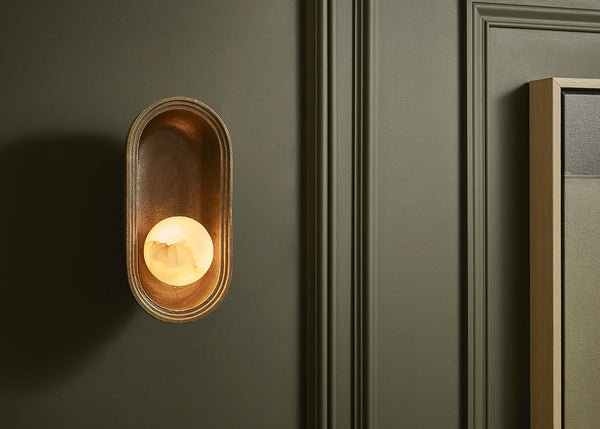
Our Corby collection, for example, brings textured cast metal together with sculpted alabaster. The contrast is visible during the day, but becomes particularly apparent after dark as light passes through the stone and catches the irregularities of the cast surface.
“We often talk about material and light as separate decisions, but they are closely connected. The material around the light source changes what you see, from the softness of alabaster to the texture revealed across a cast surface.” - Mara
It is why choosing a light is about more than its silhouette. The finish, shade and material all contribute to what happens when it is switched on, and to how that fitting works within the wider room.

5. Identify what the room is missing
Before adding something new, it is worth understanding what the room is actually missing.
A dark reading area may call for a table or floor lamp. A flat wall might benefit from wall lighting that introduces another level of brightness. A dining table can feel more defined with pendant lighting brought lower over its surface, while a room dominated by one central fitting may simply need more layers around its edges.
Small adjustments can help reveal those gaps. Move a lamp, change the balance between different fittings or try switching off the main ceiling light. The point is not to avoid adding something new, but to make sure any addition has a clear purpose.
“Sometimes moving one lamp or changing how several lights are used together completely changes the balance of a room. It also makes it much easier to see where another light could genuinely improve the space.” - Mara
Once you know what the room needs more of, whether that is warmth, focus, depth or a lower layer of light, choosing the right fitting becomes much more straightforward.
[SIDE-BY-SIDE]


A five-minute autumn lighting reset
Before making any changes, spend five minutes looking at the room after dark:
1. Switch off the main ceiling light and see what your other lights are contributing.
2. Look at the furthest corners and edges of the room.
3. Check whether visible bulbs have a consistent warmth.
4. Consider whether the light is at the right height for how each part of the room is used.
5. Step back, or take a photograph, and identify where another layer of light would make the biggest difference.
Lighting for the darker months
Autumn does not necessarily call for more brightness. More often, it calls for lighting that is better placed, more layered and better suited to the way the room is used after dark.
By paying attention to height, warmth, contrast, material and the parts of the room that disappear once daylight fades, it becomes much easier to understand what the space really needs.
Once those gaps are clear, choosing the right lighting becomes a more considered decision, whether that means introducing a wall light to create depth, a lamp to bring light closer or a pendant that gives a particular part of the room greater focus.