“Cosy season is when I really start to notice the layers within a room. It’s not about adding more for the sake of it, but using texture, material and light to make the space feel warmer and more inviting.” – Mara Miller, Industville Founder
As the evenings grow longer, we begin to notice our interiors differently. Texture feels richer, darker colours come into their own and lighting has a bigger influence on the mood of a room.
For Industville founder Mara Miller, cosy season is not about changing everything. It is about paying closer attention to material, form and proportion, then making small changes that help a room feel warmer, more layered and more inviting.
Here are seven ideas drawn from that approach, from working with shadow to using texture and contrast more deliberately.
Mara’s cosy season styling tips at a glance
- Start with texture
- Let some shadows stay
- Mix materials for warmth and contrast
- Make the room feel collected, not matched
- Create smaller moments within the room
- Give the eye somewhere warm to land
- Layer in seasonal colour and natural details

1. Start with texture
Contemporary interiors can sometimes feel overly uniform, especially where the architecture is clean and restrained. Texture helps bring back depth.
That might come through ribbed glass, cast metal, natural stone, woven fabric or timber. Each surface responds to light differently, so even a simple material change can alter how a room feels once the daylight starts to fade.
This is particularly effective where the scheme needs more character without more decoration. Physical, weightier details can help ground the room and give cleaner spaces something for the eye to settle on.
Lighting is an easy place to introduce that tactility. A ribbed glass pendant from the Noho collection, a cast metal wall light or a piece from our alabaster lighting collection can add depth through material alone.
[SIDE-BY-SIDE]


2. Let some shadows stay
A cosy room does not need to be evenly bright.
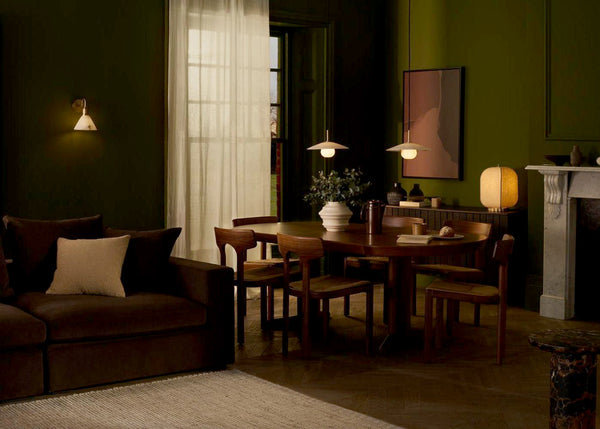
In fact, one of the most effective ways to make a space feel more intimate is to manage shadow rather than remove it. Low-slung pendants, wall lights and reading lights create focused pools of warmth exactly where they are needed, while the rest of the room is allowed to soften around them.
This can also change the perceived scale of a space. When the light draws inward, the room feels more contained and settled, which is especially useful in bedrooms and living spaces after dark.
Try turning off the main ceiling light for an evening and see which areas you actually use. You may find the room feels better with less light overall, just placed more carefully.

3. Mix materials for warmth and contrast
Some of the most interesting rooms bring together materials that feel very different from one another.
Polished glass beside textured metal. Soft fabric against stone. Something smooth next to something deliberately raw.
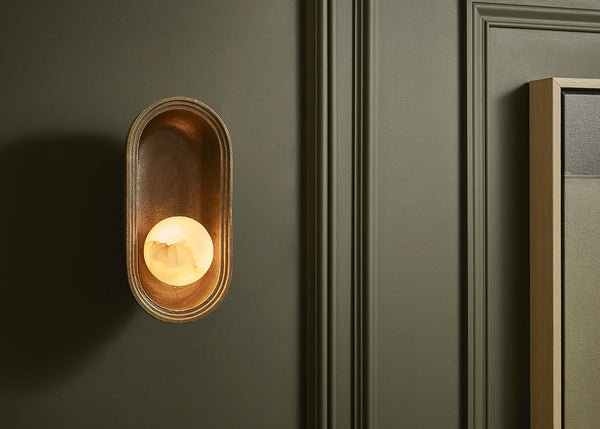
The Corby collection was designed around that kind of contrast, pairing heavily textured cast metal with the milky softness of alabaster. One material gives the piece weight and structure, while the other softens both the form and the light.
It works because the materials are not trying to match. Each one brings something the other does not.
You do not need many different finishes to achieve this. Two or three materials with distinct qualities are often enough to make the room feel more layered and more tactile.
[SIDE-BY-SIDE]


[/SIDE-BY-SIDE]
4. Make the room feel collected, not matched
A room tends to feel more natural when every light is not from the same family.
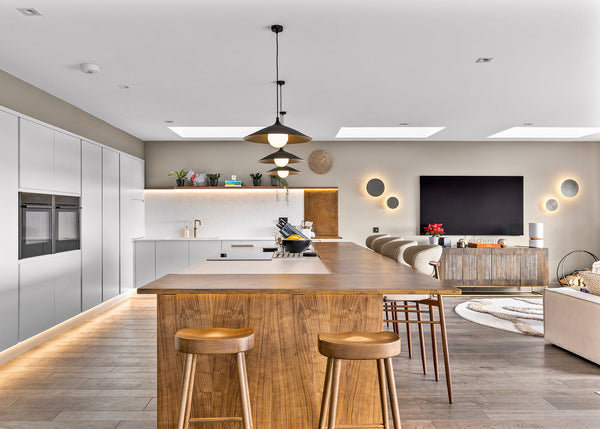
The connection can come from somewhere else. In an open-plan kitchen and dining space, for example, a repeated brass finish can create a visual line between larger statement pendants and smaller glass fittings, even when their scale and form are completely different.
That shared material palette gives the scheme enough continuity without making it feel over-coordinated.
It also allows each light to do the job it is best suited to. Larger fittings can anchor the dining area, while smaller pendants or wall lights support the architecture elsewhere in the room.
Explore the wider Industville lighting collection to see how different shapes and scales can work together through a shared finish or material.
[SIDE-BY-SIDE]


[/SIDE-BY-SIDE]
[P3-P3]
5. Create smaller moments within the room
Cosy spaces are often built around smaller moments rather than the room as a whole.
A chair beside a lamp. A reading spot. A bedside pendant. A piece of artwork picked out by a dedicated light.
These areas work best when the lighting responds to what is already there. In the same way that a channelled headboard can give a bedroom structure, a wall light can echo that geometry and begin to feel like part of the architecture rather than something added afterwards.
This is where placement matters as much as the fitting itself. Look at the lines created by panelling, shelving, furniture and artwork, and use those as a guide.
Sculptural designs such as the Corby wall lights can work especially well when they relate to the shape and rhythm already present in the room.

6. Give the eye somewhere warm to land
Some of the most inviting rooms have one area that feels especially good after dark.
It might be a reading chair, a listening corner, a dining table or a piece of artwork. The rest of the room does not need to compete with it.
Low-level lighting is particularly effective here. Softly diffused light can create a gentle background glow, while warmer metallic finishes catch the light and add depth around it.
There is also a sensory side to this. Soft textiles help absorb sound, while lower lighting levels reduce visual contrast and make a space feel more settled. Together, those choices can make a room feel better suited to reading, listening or simply switching off at the end of the day.
If you prefer a softer glow, our alabaster lighting collection is a useful place to look. The natural stone diffuses the light passing through it, giving it a gentler presence in the room.

7. Layer in seasonal colour and natural details
Cosy season does not need to mean filling the room with seasonal decoration.
Deeper reds, olive greens, warm browns and earthy neutrals can shift the mood without changing the underlying scheme. They work particularly well alongside aged metals and softly glowing alabaster.
Natural details can do the same job. Branches, foliage and seasonal flowers bring in shape and movement without making the room feel themed.
The strongest seasonal schemes are often the most restrained. One sculptural branch, one richer backdrop or one softly lit corner can be enough.
The same thinking can carry through into Christmas. Tonal richness and a few carefully chosen details often feel more considered than traditional decoration used everywhere at once.
[SIDE-BY-SIDE]


[/SIDE-BY-SIDE]
A cosier home is built in layers
The most effective seasonal changes are often the least dramatic.
Introduce more texture. Let some areas stay darker. Repeat a finish across different forms. Give one corner a stronger sense of purpose.
These details change how a room feels without changing what makes it yours.
That is really the point of cosy-season styling. It is not about replacing the room you already have, but bringing more warmth, depth and comfort to it through the months when home matters most.
Explore the full Industville lighting collection, or discover our alabaster, Corby and Noho designs for more ways to bring warmth, texture and character into your home.

About Mara Miller
Mara Miller is the founder of Industville. Since establishing the brand in 2013, she has developed a collection centred around material, proportion and enduring design, drawing inspiration from British heritage and interiors around the world.
Her approach focuses on creating lighting that works naturally within the architecture of a space, using materials including glass, metal and alabaster to bring texture, warmth and character to contemporary interiors.