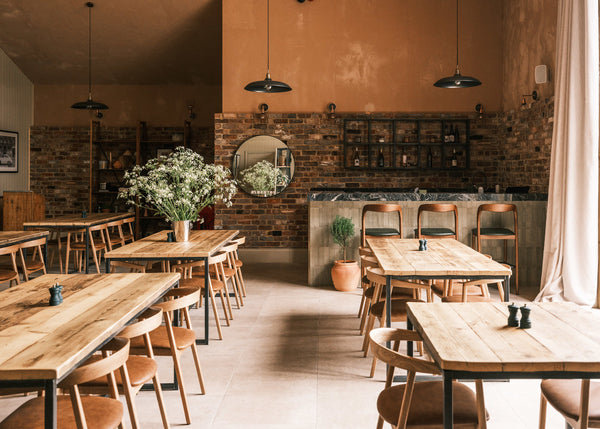
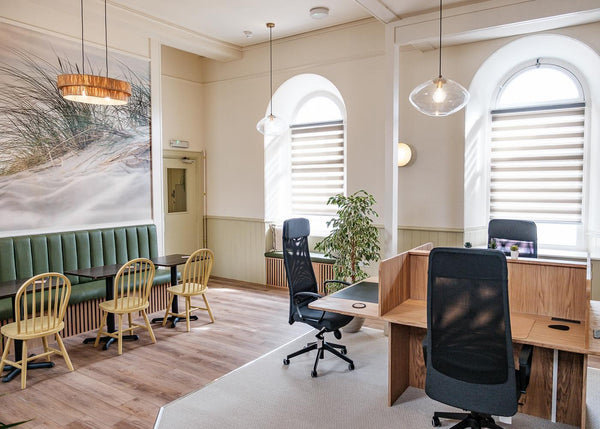
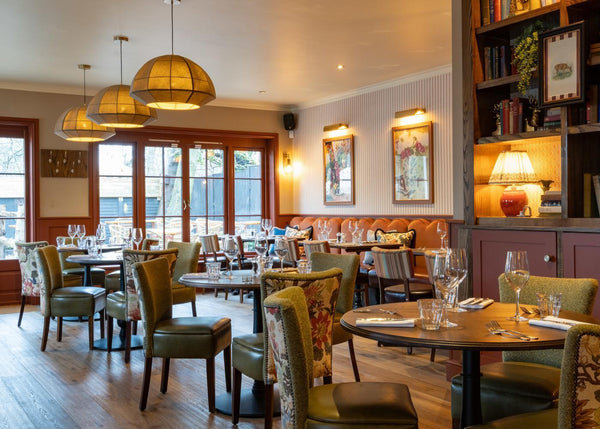
In the heart of Saltburn-by-the-Sea, Milton Street Market has given a former Methodist church a completely new purpose. The Grade II listed building has been transformed into a contemporary food and drink destination, bringing together four independent kitchens, a central bar and communal spaces while retaining the architecture that gives the building its character.
Rather than disguising the building's past, the design works with it. Original stonework, soaring proportions and historic windows remain central to the space, while new interventions introduce the warmth and atmosphere needed for a busy hospitality setting.
Industville pendants are used throughout, helping to bring the vast interior to a more human scale without competing with the architecture around them. We spoke to Freddie Armstrong, Managing Director of 23 Milton Street, about the transformation, the challenge of designing within such a distinctive building and what it has been like to see the church become a gathering place once again.

What drew you to converting a former church?
"The building had an enormous amount of character already, so from the beginning we felt the worst thing we could do was fight against that. We wanted to create something commercially viable and completely different for Saltburn, while still making it feel like you were walking into a former church.
The approach was really about working with the building rather than trying to turn it into a conventional hospitality space. Milton Street Market was designed as a food hall with four independent kitchens, a central bar and a large communal seating area, which allowed us to make use of the scale and openness of the church without breaking it up unnecessarily."

Which original features were most important to preserve?
"For us, it was important to retain as much of the character and fabric of the original church as possible. The proportions of the building, the stonework, windows and architectural details are what make the space special, and we wanted those features to remain the focus rather than covering them up.
There was a conscious effort throughout the renovation to make the new elements feel sympathetic to the building. You should still immediately recognise that you're sitting in a historic church, even though it's now operating as a busy, modern food and drink venue."
How did the building’s scale shape the design?
"The scale was both one of the biggest opportunities and one of the biggest challenges. It's a very large, tall and open space, and we didn't want the finished venue to feel cavernous or empty. The bar, kitchens, furniture and lighting all help bring things down to a more human scale while leaving the height and openness intact.
We can seat around 200 people, but because of the volume of the building it still feels spacious. Once it's busy, that scale really comes into its own, there's a huge amount of atmosphere without the space feeling overcrowded."

What role does the lighting play?
"Lighting was particularly important because of the height and scale of the church. During the day there is plenty of natural light and the architecture does a lot of the work, but as the day moves into evening the lighting completely changes the character of the building. We wanted warmth rather than bright, uniform commercial lighting.
The pendants help visually lower the space, create more intimate areas within such a large room and draw attention to the bar and communal areas, while still allowing the architecture above to remain visible. In the evening especially, the lighting is a huge part of the atmosphere.
We wanted fittings that had enough presence to work within a building of this scale without competing with the architecture. The Industville pendants have that slightly industrial, timeless quality which works particularly well against the historic fabric of the church.
They feel substantial enough for the space and give us the warm, relaxed light we wanted, but they don't look overly decorative or like we're trying to recreate what might originally have been there. That balance between old and new was important throughout the project."

How does the space feel now that it's open?
"Seeing it full of people has probably been the most rewarding part of the whole project. You can spend months looking at plans and walking around a building site, but you don't really know whether a hospitality space works until people are actually using it. Since opening, we've had weekends with around 200 people eating, drinking and socialising in the building, and that's when everything makes sense.
It has a real buzz and atmosphere, but the scale of the church means it can absorb a lot of people without losing its character. In many ways, it feels like the building has become a gathering place again, just with a completely different purpose.
That sense of bringing people together is also central to how Milton Street Market describes the venue today, with its programme extending beyond food and drink into live music, pop-ups, sporting events and seasonal occasions."
[SIDE-BY-SIDE]


[/SIDE-BY-SIDE]
How did you balance old and new?
"We deliberately avoided trying to make everything look historic. The original building provides more than enough character, so the new interventions, the kitchens, bar, lighting, furniture and signage were allowed to be contemporary provided we stuck to our golden rule of only ever introducing high quality materials into the space.
I think that contrast is actually what makes the space work. You're very aware that you're in an old church, but you're equally aware that Milton Street Market is a modern venue. The aim was always for the two to complement one another rather than for the new elements to imitate the old."

What has been the biggest success?
"For me, the biggest success is that the building doesn't feel like a converted church that's simply had a restaurant put inside it. It feels like Milton Street Market has found a natural home within the building. The architecture, street food kitchens, bar, communal seating and lighting all contribute to the atmosphere, but none of them dominate it individually.
When the building is full on a Saturday evening, with all four kitchens busy, the bar full and people throughout the space, it feels like the building is being properly used again. We get a huge amount of pleasure from knowing that we've created something the whole town can enjoy, and that many thousands of people are once again getting to experience such a fantastic building. Seeing a space like this brought back to life and enjoyed by so many people is probably the most rewarding part of the whole project."
[SIDE-BY-SIDE]


[/SIDE-BY-SIDE]
The key takeaway: work with what is already there
Milton Street Market demonstrates the value of allowing the character of a building to lead the design. Rather than recreating the past or obscuring it with an entirely new identity, the contemporary elements have been chosen to sit confidently alongside the existing architecture.
For lighting in particular, that means thinking beyond brightness alone. Scale, materiality and the position of each fixture can help define more intimate spaces within a large interior, while still giving the architecture room to be experienced.
Our founder Mara observed, “Milton Street Market is a great example of what we mean by light with substance. In a building with this much scale and architectural character, the lighting needs enough presence to belong without fighting for attention. The pendants help bring warmth and a more human scale to the interior, while allowing the original architecture to remain the focus.”
A new chapter for Milton Street
The success of Milton Street Market lies in the relationship between old and new. The church remains clearly legible, but its scale and character now provide the backdrop for a very different kind of communal space.
From the four kitchens and central bar to the lighting overhead, each new element has been introduced with enough substance to feel at home within the architecture without overwhelming it. The result is not simply a historic building preserved, but one given a relevant new purpose and filled with people once again.
[P1-P1]