At Industville, we have never been overly fond of the word “trend.” Design, at its best, should feel timeless rather than temporary. Yet trends do play a role in shaping the wider conversation about how we design spaces, what we value, and how the way we approach design evolves with our customers' needs and expectations. They highlight shifts in mood and material that reflect something deeper about culture and craftsmanship.
The year ahead points to a more thoughtful kind of evolution. One shaped less by novelty, and more by refinement. A return to depth, proportion and restraint. The trends we are seeing for 2026 are not about chasing the new for its own sake, but about designing spaces that feel grounded, expressive and quietly confident. Places where light is considered as carefully as form, where materials are chosen for their character as much as their performance, and where every detail has a reason to be there.
Ten trends defining 2026
1. Material Narratives and Texture
Design in 2026 is anchored in material presence. Surfaces are no longer passive backdrops but active storytellers. Brushed metals, honed stones, and tactile ceramics bring depth and credibility to large-scale interiors, offering a language that feels authentic rather than applied.
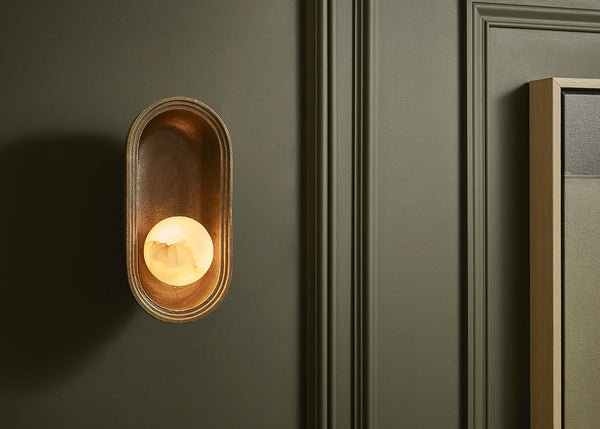
Natural stone lighting, particularly alabaster, is becoming an increasingly valued part of this conversation, prized for its soft translucency and subtle variation, qualities that allow light to feel atmospheric rather than purely functional.
For commercial spaces, this approach allows brand identity to be expressed through atmosphere rather than overt messaging. Texture, finish, and the way materials interact with light can quietly underpin a brand’s character without relying on dominant logos or statement colours. It is a more enduring form of recognition, one that feels considered, architectural, and inherently part of the space itself.
[SIDE-BY-SIDE]


[/SIDE-BY-SIDE]
[P1-P1]
2. Zone-Based Layering
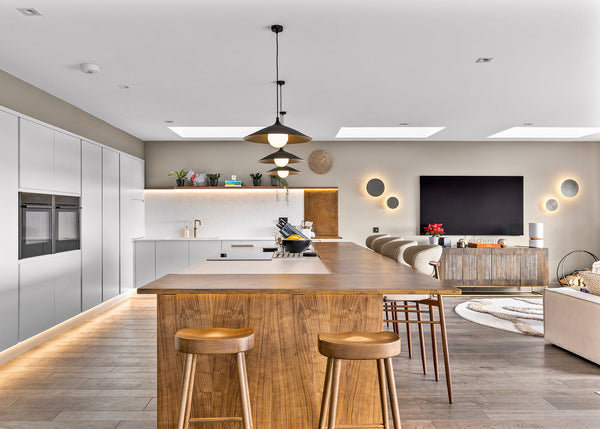
Large commercial environments are increasingly shaped by how people move through them, not just how they occupy them. Instead of uniform lighting across entire floors or venues, designers are using light to articulate zones within open plans: arrival points, circulation routes, moments of pause, areas of focus, and social thresholds.
This layered approach allows a single space to perform multiple functions without physical division, an idea explored in our Rotherfield project, where lighting was used to subtly guide behaviour and mood across adjoining areas. In commercial settings, this becomes a powerful tool for improving flow, comfort, and spatial clarity at scale.

Cocoon & Bauer / @cocoonandbauer
3. Curated Colour and Tone
Colour strategies in 2026 are becoming more restrained and deliberate, particularly within hospitality, retail, and workplace environments. Designers are favouring cohesive tonal families that support longevity and adaptability over seasonal statements.
Deep mineral shades, softened neutrals, and layered mid-tones create backdrops that allow lighting, materials, and architecture to lead. This quieter palette also provides flexibility for brands that evolve over time, allowing interiors to remain relevant without constant visual reworking, a philosophy closely aligned with the principles behind newstalgia.
[SIDE-BY-SIDE]

[/SIDE-BY-SIDE]
@kipandnook
[P2-P2]
4. Subtly Integrated Tech
Technology continues to shape commercial interiors, but its most successful applications are increasingly discreet. Rather than lighting needing to be “smart” in itself, many projects now rely on centralised building management systems and integrated lighting controls that allow environments to shift seamlessly throughout the day.
In hospitality especially, simplicity still holds considerable value. A well-specified dimmer remains one of the most effective and cost-efficient tools for controlling atmosphere, offering intuitive flexibility without unnecessary complexity. This balance between intelligence and restraint ensures spaces remain responsive while preserving the tactile, human quality that guests and occupants respond to most strongly, echoing the subtle emotional cues explored in our article on indoorphins.
[SIDE-BY-SIDE]


[/SIDE-BY-SIDE]
@sampsonassociates | BathPizzaCo
[P3-P3]
5. Sculptural Illumination as Architecture
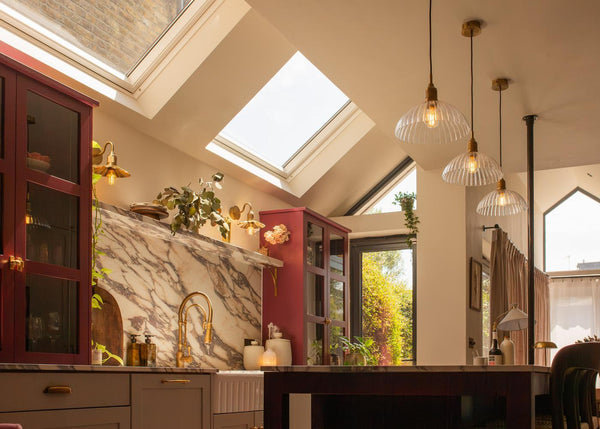
Lighting is no longer treated as a secondary layer applied after architecture is complete. It is increasingly specified as part of the spatial structure itself. Elegant pendants, refined linear systems, and sculptural wall lights are being used to establish rhythm, scale, and visual hierarchy across large interiors.
For designers and specifiers, this means lighting selections now contribute directly to how a space is read and remembered. Fixtures define ceilings, frame volumes, and create visual anchors that remain legible across open, multi-use environments. They move beyond decoration, becoming part of the architectural language itself.

Conclusion
These shifts in design reflect a broader move toward commercial spaces that feel measured rather than momentary. Interiors shaped by proportion, material honesty, and lighting that is specified with intent. Spaces that support both the practical demands of daily use and the quieter emotional responses that define how people experience them over time.
If you are exploring new ideas for an upcoming project, our collections are available to discover online, from ceiling lights and table lamps to characterful decorative bulbs and our most considered bestsellers, each designed to sit comfortably within both contemporary and heritage-led commercial environments.
And for those working across ongoing or multi-site projects, our trade team are always on hand to offer guidance, technical support, and bespoke solutions. You can register your interest or begin a conversation here, and explore how considered lighting can quietly strengthen the character of the spaces you shape.